Take yourself on a sound walk around Govanhill, exploring refugee histories,
food cultures and the built environment. At each stop, listen to audio of the conversations, recommendations and insights of the community historians of Milk Glasgow.
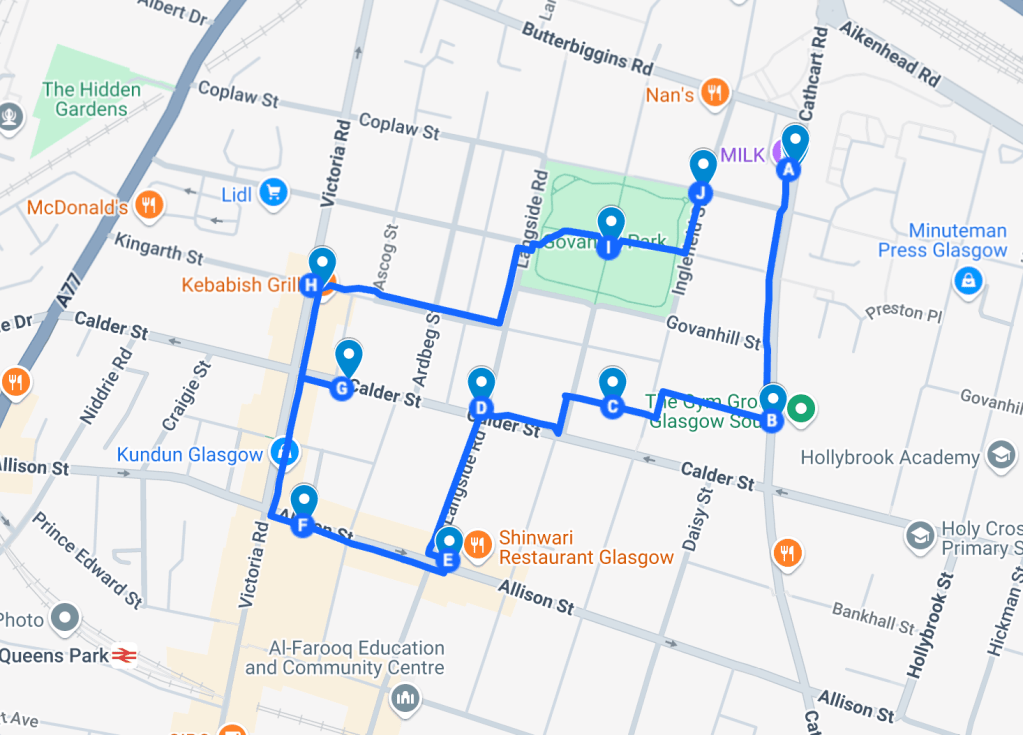
Accessibility: This walk lasts 2km on city pavements and will take you around an hour. There are no steep hills on the route. An accessible toilet is available at Govanhill Library during opening hours. Some seating is available at the corner of Victoria Road and Kingarth Street as well as in Govanhill Park. For detailed walking directions click on the map:
Start: Milk, 378 Cathcart Road
Govanhill is the most diverse neighbourhood in Scotland. More than 88 languages are spoke in the area, and people from over 55 countries live here.
This walk takes you through space and time, exploring histories of migration and the power of food to connect us with the past, and with different cultures and traditions. Refugee histories are not something separate to Scottish history – refugee history is Scottish history. You can’t understand the history of Scotland without engaging with longstanding histories of immigration and emigration, and how those have shaped the country, its people and its built environment.
Stop 1: The People’s Pantry, 488 Cathcart Road
Every vegetable we grow, in our land, I get delicious vegetable. The farmers are very hard workers.
Food is a powerful connector to culture, memory and community. This is the People’s Pantry, which is a membership-led shop providing access to affordable, nutritious, and culturally appropriate food.
We chose to look at refugee histories in the built environment through food cultures on this tour because cooking, sharing and enjoying foods from different countries and cultures is such a key part of not only the Milk community but also the wider neighbourhood. Food can connect people, even when they feel quite alone.
About 9 months ago I came here from my own country. I should be strong, I know that, because I’m here alone, I don’t have any family, just my husband.
Stop 2: Welcome to Govanhill, South Annandale Street
This mural is a rare piece of artwork in Glasgow’s built environment which celebrates immigrant cultures alongside those of the longer settled communities of Govanhill. It is part of the Govanhill Open Museum project and was painted in 2022.
Can you recognise all the textiles shown on the mural? Read more about the mural in Greater Govanhill magazine here to find out about the traditions and cultures represented in each letter.
Stop 3: Govanhill library, 170 Langside Road
The library was built in 1906. It is one of 8 Glasgow libraries funded by Andrew Carnegie, the Scots American millionaire.
The statues show a woman reading to her children, representing knowledge. On the top is a bronze angel standing on one leg. In 1995 she was stolen by four men who pretended to be workmen taking her away for renovation. She was later recovered by the police and returned to her rightful place.
Libraries are important places for asylum seekers, refugees and many other people. They are warm, safe spaces where you can read, learn and relax without spending any money.
[in the library I] sometimes reading, talking, playing with my daughter.
The windows documenting people’s histories of the neighbourhood are part of a series in different Glasgow Libraries by stained glass artist Keira McLean. These were, in her words, “made with love and determination by the diverse communities of Govanhill.”
Stop 4: Glasgow Sweet Centre, 202 Allison Street
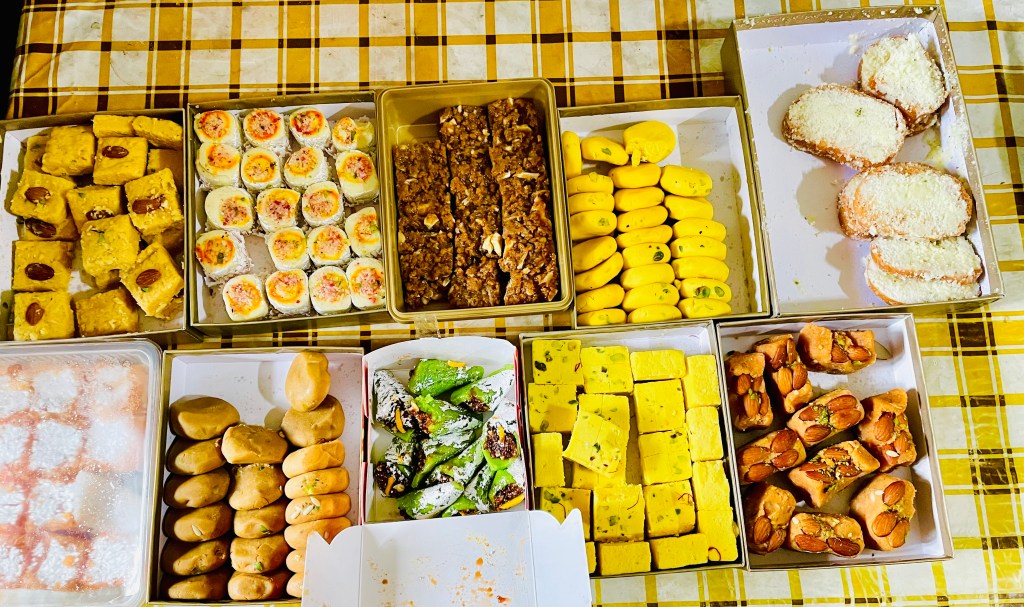
This is one of many shops in the area where you can sample an array of sweet treats. It was chosen by one of the tour researchers, who said the shop is famous for fresh jalebi.
On special occasions, especially on Eid, we can cook some sweet dishes like rasmalai, jalebi. We can buy from shops, especially because it takes a long time to make at home. We can buy it from shops like Glasgow Sweet Centre and it’s very delicious.
In that clip the speaker mentioned the delicious dessert rasmalai. Traditionally the recipe involves making curd cheese by hand, forming into balls which are cooked in sugar syrup and then served in a creamy milk-based sauce:
We make small balls for this rasmalai, and put it in the other milk, we boil milk and add some sugar and cut almonds, and boil 10-15 minutes. And the small balls go to big size.
This takes several hours, but luckily there is another option:
We can get readymade rasmalai material from the shop, and we can mix it boil it up with milk until it thickens, and drop all the balls in it.
Stop 5: Desi Curry Palace, 144 Allison Street
Writer Samia Shams takes the reader on a food tour of Govanhill in her piece for Milk’s food blog, Exploring the Desi Delights of Victoria Road: A Culinary Journey Through Southside Glasgow. Listen to a member of the Milk community share Samia’s words:
Our first stop was at Desi Curry, a cozy eatery known for its aromatic curries and flavourful biryanis. Stepping inside, we were greeted by the tantalizing scent of spices and the welcoming smiles of the staff. With eager anticipation, we ordered an array of dishes, from creamy butter chicken to spicy lamb karahi, each bite bursting with authentic flavours that transported us to the streets of Pakistan.
There is a longstanding South Asian community in Glasgow. In the 19th century sailors known as lascars worked in the Glasgow docks, while the first Indian students graduated from Glasgow University in the 1870s. Many people joined pioneering early family members who moved to Scotland and worked as pedlars and shopkeepers.
The partition of British India in 1947 into the two independent countries of India and Pakistan displaced at least 14 million people, some of whom fled to join the community here in Glasgow. In more recent years, many refugees and asylum seekers in the city are from Pakistan.
Stop 6: Govanhill Baths, 126 Calder Street
Govanhill Baths was opened in 1914. Many local people learned to swim here by the method of tying a rope round a bicycle inner tube, which wee kids clung to so they wouldn’t sink during the lessons. See a picture of this in action here.
As well as swimming, there were also facilities where people could wash their clothes, and a bathhouse. This was essential as many flats in the area did not have good facilities for washing yourself or your clothes. Learn much more about the history of the building and the people who used it in the books United We Will Swim | 100 Years of Govanhill Baths and 99 Calder Street: A History of Govanhill Baths and Washhouse.
The pool served the people of Govanhill well until 2001, when the council threatened to close it down. The local community immediately sprang into action and the Save our Pool campaign was born. A dozen people broke into the closed building and chained themselves to the cubicles, leading to an occupation that lasted for almost five months that year in an effort to save the baths. This was the longest occupation of a civic building in British history.
The Baths is now run by a community trust. The building is currently shut as part of a large-scale renovation project but due to open again as a pool hopefully in the near future.
Stop 7: Corner of Victoria Road & Kingarth Street
Tenements in Govanhill were quickly built to house workers and immigrants who came to Glasgow in the late 19th and early 20th century. Many lacked indoor toilets and washing facilities, which is one reason why Govanhill Baths was such an important place in the neighbourhood.
You can spot the difference between these tenements and the ones that were built for the middle classes in nearby areas like Pollokshields or Strathbungo: the Govanhill ones are denser housing with four floors, whereas the Shields ones generally have three.
Tenements are often different to the types of houses refugees lived in before coming to Scotland.
In Kurdistan, the houses are very big, one house can have 10 people. Glasgow is famous for its tenements. This kind of building with a shared entrance and multiple flats inside is also common in Edinburgh, New York and Berlin.
Stop 8: Govanhill Park
This is Govanhill Park. Every year people gather here for the Govanhill Carnival Parade, a colourful, noisy and joyous walk through these streets which is part of a wider Anti-Racist Festival of Creativity, Solidarity, and Liberation.
Nearby, the much bigger Queens Park is an important place for many refugees living in the area due to its peaceful green spaces and good views.
Joseph Paxton, who designed Queens Park, was also the person who first cultivated the Cavendish banana, that is the yellow one we are familiar with here.
In Queens Park there are several trees planted by refugee communities in Glasgow. One commemorates a massacre of Kurdish people in Halabja, Iran and the other was planted by Belgian refugees who lived in Glasgow during World War 1.
You can find the Halabja tree if you climb the stairs at the top of the main path from Victoria Rd. However the Belgian tree has lost its plaque and nobody remembers which one it is.
Stop 9 Coplaw St
The Avrom Greenbaum Players were an internationally renowned Jewish theatre group named after a Polish-born Glasgow playwright and actor. They performed hundreds of plays in a building on this street, the former hall at number 49, which is opposite Cuthbertson Primary School.
This area, from the Gorbals to Queens Park was once home to Glasgow’s large Jewish community which had its own linguistic, religious and culinary traditions.
Writer Chaim Bermant remembered the range of butchers, bakers and grocers serving the Jewish community in the area, describing grocers with barrels of herring in the doorway. The herrings in particular brought a strong whiff of home.
In today’s Govanhill, like in the Gorbals of the 1930s, grocers and fruit shops cater to immigrant and refugee communities, from Moroccan soft drinks and Syrian flatbread to Ukrainian pickles and dumplings. Some things however, never taste quite the same:
[In my country we grow] different types of oranges, and watermelon. Melons! Different kinds of melon – it’s all sweet, and so delicious, I miss it so much!
End: Milk, 378 Cathcart Road
I find Milk very friendly, they have very friendly people that I meet. And also I like coming more, I’d like to continue coming in here… my first time when I meet them, I didn’t think it’s my first time I think it’s my maybe 10th or 11th time I came in here, it’s not the first time.
Milk is part of Glasgow’s network of organisations providing support and solidarity to refugees and migrants. Such spaces have a long history in the city, from the 1930s refugee centre on Sauchiehall Street through to integration networks, grassroots networks and local organisations, all dedicated to fighting for people’s rights and supporting the building of community.
Any ethnicity, any religion, any country – we are together in this community. And they welcome everyone.
The importance of spaces like these for support, learning, making new friends and sharing skills cannot be underestimated.
It’s quite good to come here and meet different people and come and sit with different people and I love it.
Hopefully by coming on this tour you have heard some new voices, and learned some new things about our neighbourhood!
This sound walk was a collaboration between Milk, Migrant Voice, Radical Glasgow Tours and the Scottish Refugee Council, grant-aided by Glasgow City Heritage Trust. It was created for Refugee Festival Scotland 2025.

The audio clips were recorded by Sarah Ali, Yaaeen, Aiza, Mehr, Iqra, Farah and Farhiya. By recording lines created by other members of the community alongside their own, they did important work in helping include a wider range of refugee voices in this tour.
The tour was created by the collective community of Milk, over a series of themed conversation sessions, community mapping, audio and zinemaking workshops. The theme and the content of the stops reflect (some of) the interests, knowledge and histories of the women involved. Thanks to Kim for sharing mouthwatering food writing from Milk’s Substack!
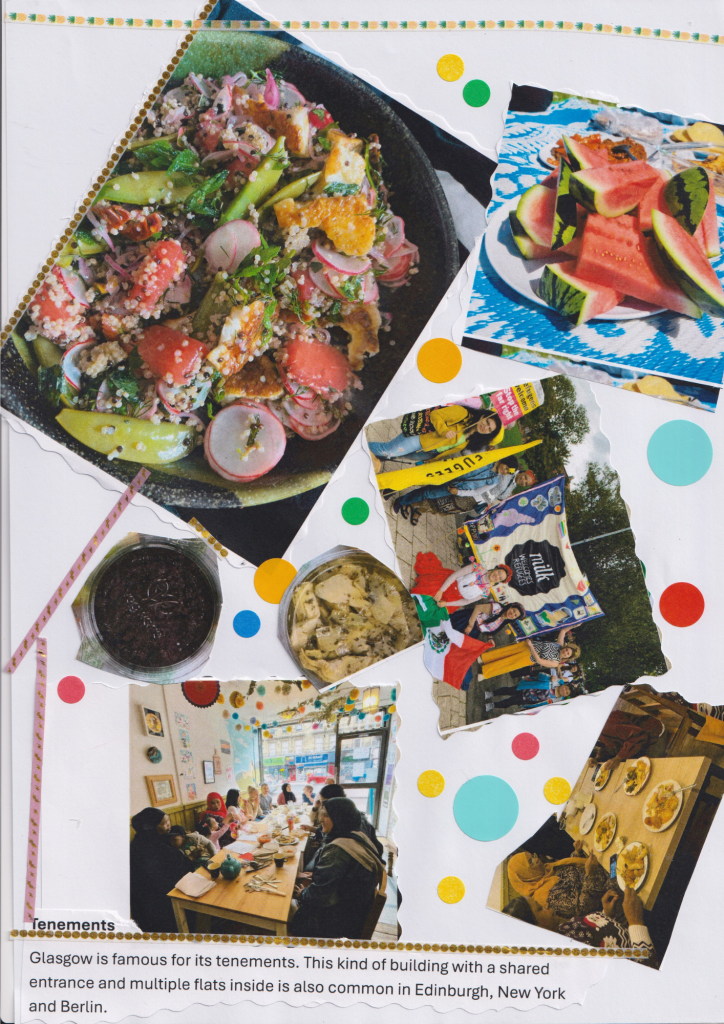

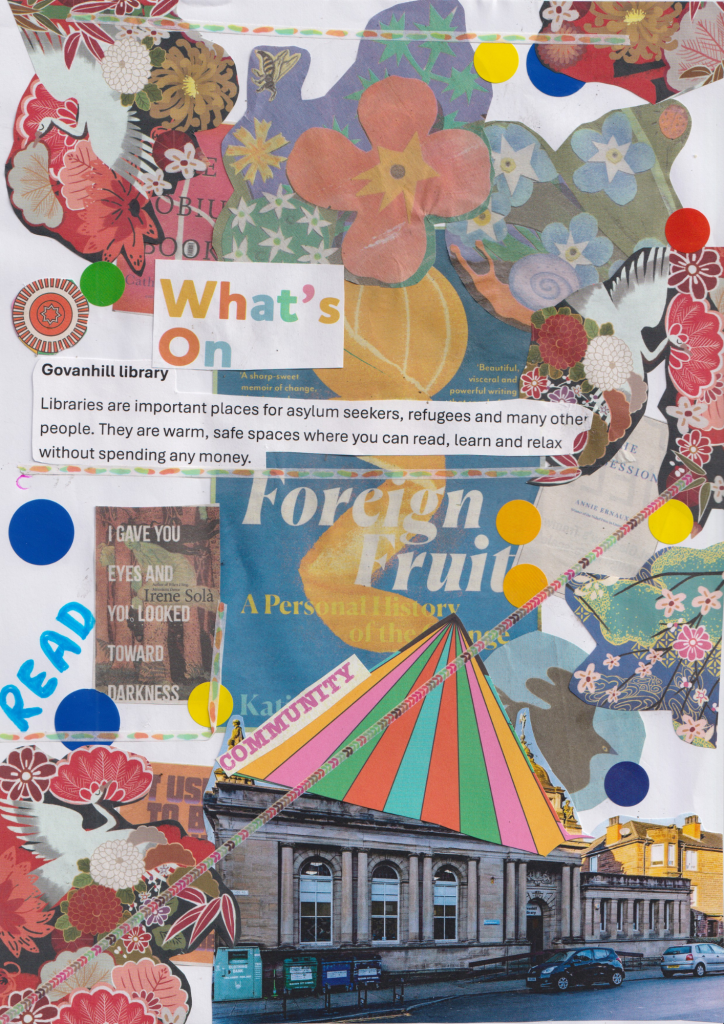
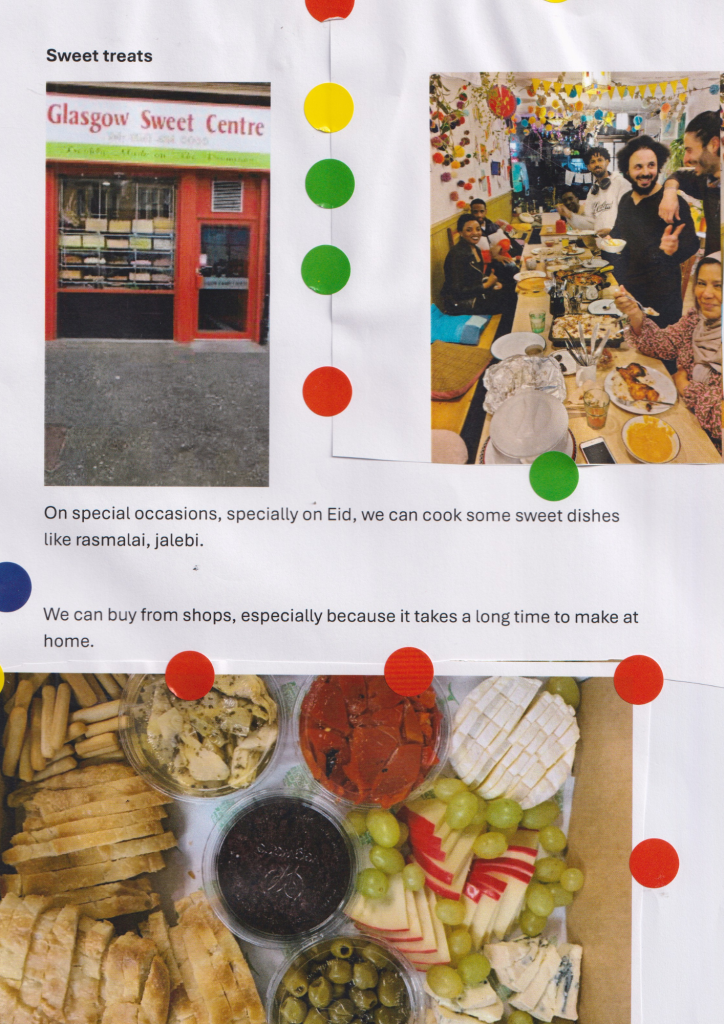
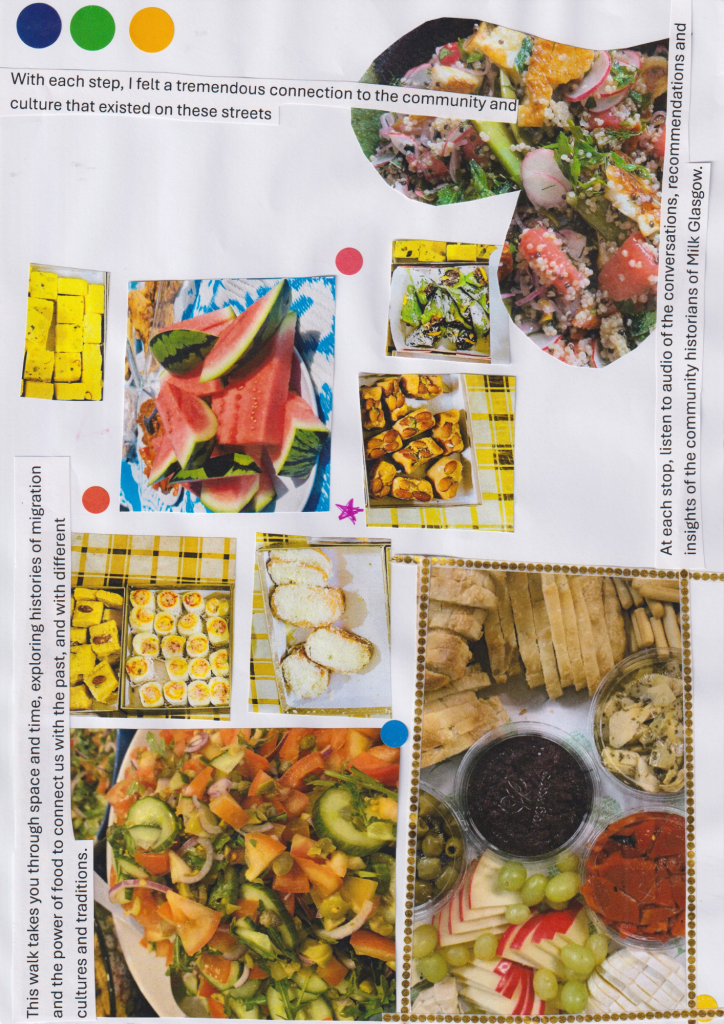
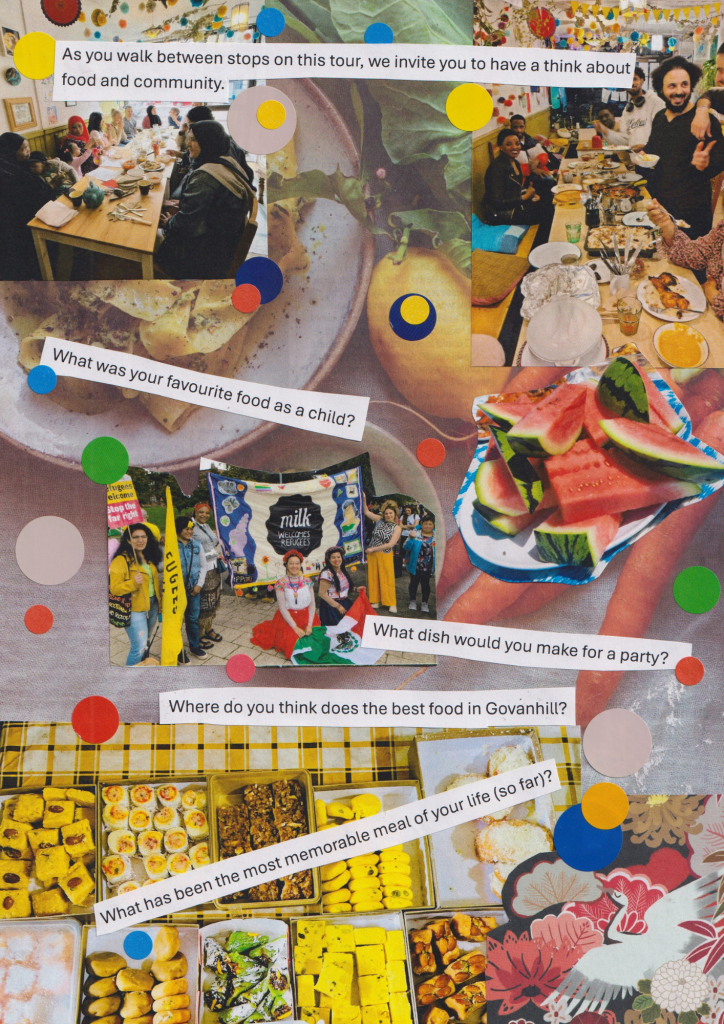
Collages created at Milk for the publication which accompanies this walk. You can download and print your own on our resources page.
 Radical Glasgow Tours